
Review: The Odyssey, Directed by Christopher Nolan
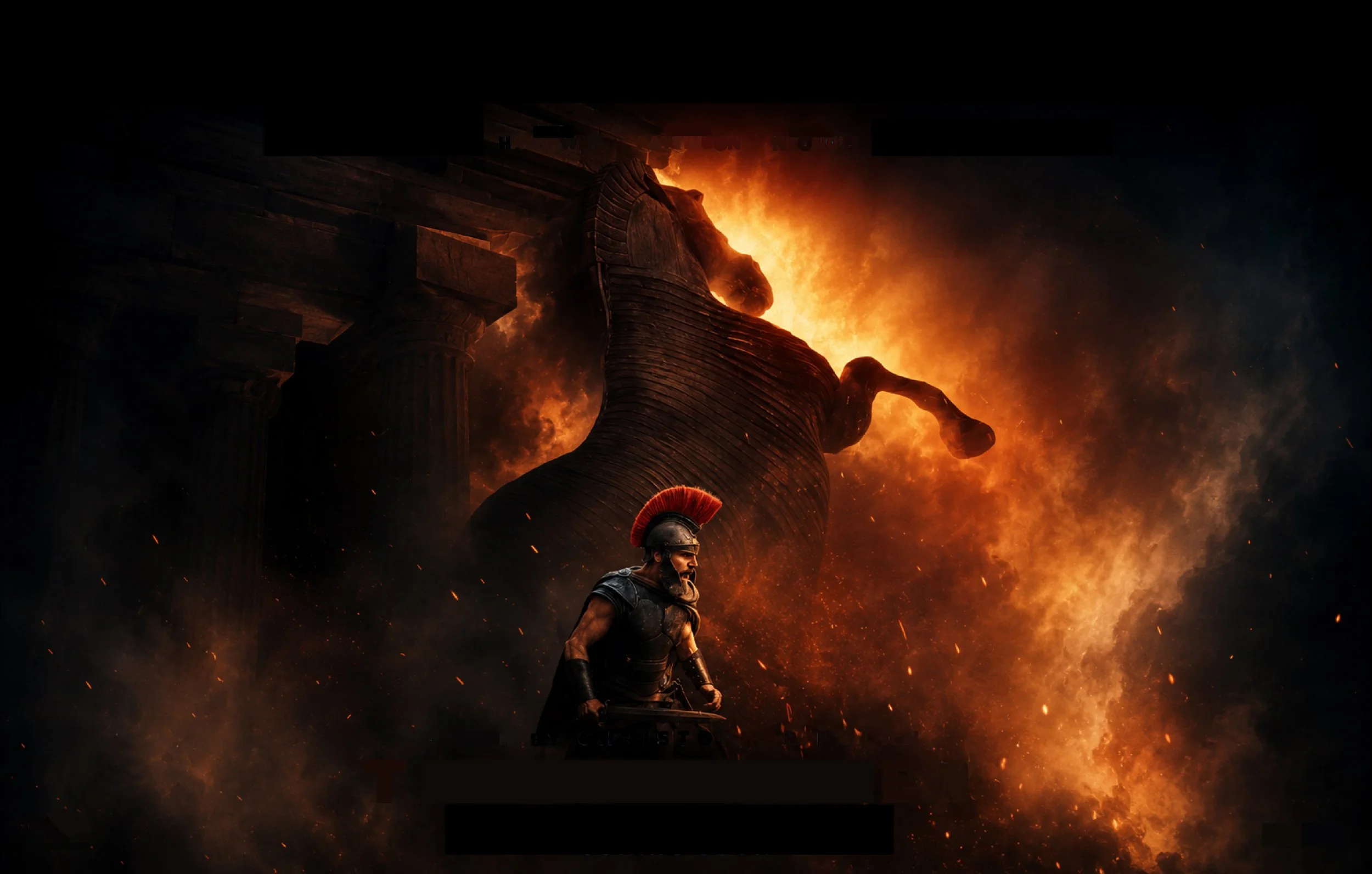
If one were to judge by his new film, Christopher Nolan hates God or gods, strong and beautiful women, obedience and loyalty, oh, and the bond of father and son. His bombastic deconstruction of the values of the universal genius, Homer, makes his film small and nasty—no matter how many panoramic shots he backs up with a bullying, thunderous score designed to cover up all the weakness of the characters and words.
For Homer, the Trojan War was a punishment demanded by Zeus, the King of the Gods, the giver and protector of universal law, upon Troy for allowing the violation of guest hospitality when Paris stole Helen (Zeus’s daughter) from her husband, Menelaos. Greek city states and particularly Argos, ruled by Agamemnon, had the burden and the glory of inflicting that inevitable punishment. For Homer, as for the Christian, those closest to the will of God will suffer much. This is partly because that is the price of glory, and partly because those who walk with the gods are in constant danger of pride and excess. Agamemnon is tasked with leading the armies of many kings. Thus he is the King of kings, chosen by Zeus. Most of the other kings were bound by their oath to protect the rights of the husband of Helen, if they were not chosen to marry her. Homer’s Agamemnon does not slay his daughter, Iphigenia, because he is money hungry or eager for blood, but because Zeus made it his responsibility to get the armies to Troy and that is the only way it can happen. But Nolan falls for the silly vision of this great king as driven by petty greed, even as he has everyone sincerely drop to their knees at his mere appearance.
The film fails to convey any of Homer’s sense that Zeus desires the war as justice, while wise Athena guides and helps Odysseus at every major turn. Homer’s Athena even allows the hero to steal the Palladium, the ancient wooden figure made in her honor, since Troy cannot fall—as she wishes it to do—until the Palladium’s protection is taken from the city. Nolan even neglects to acknowledge the ancient tradition that the Trojan Horse was Athena’s idea, given to Odysseus to fulfill. In Homer, Athena pleads for Odysseus’s release from the goddess Calypso, who lovingly imprisons him for seven years, offering him immortal life and endless youth. Homer’s Athena in disguise urges his son to go looking for him, so that Telemakhos can become a man, rather than just a good son to his virtuous mother. She turns Odysseus into a nauseating looking beggar as disguise, and then to a younger and more vivid version of himself for the sake of his wife and son. She is always with him when he needs her most.
The director grasps a shred of Homeric concept when he sees that there was sin that displeased the gods as the Greeks leveled Troy. This sin was behind the bad storms that broke apart the fleets sailing back to Greece. It is a theme hard to miss in the written epic since it is expounded at length by Zeus on the third page—man is mainly responsible for his own sufferings on earth. But Nolan is not interested in gods or eternal moral laws. Instead, poor Matt Damon has to suffer a ten-year emotional breakdown over the violence at Troy, and the supposed violation of guest hospitality involved in the Trojans hauling the Greek-occupied Horse inside. Talk about incoherent use of a great idea. Fortunately for Damon, Nolan has Calypso, the radiant goddess, drug him with lotos for seven of those years (yes, the same lotos that Homer’s Odysseus rejects early on in the poem). Can anything be duller than this reduction of godly justice to psychobabble that ignores any motivation but man? It is the same fatal error performed when Aragorn was made a tormented doubter of his actions in The Lord of the Rings. Can’t any A-list director get past sniveling self-doubt except Mel Gibson?
Odysseus wanders for most of ten years as a matter of justice. Poseidon is angered at him and Zeus allows this punishment, not death. But it is not because the man put out the eye of Polyphemous, the disgusting brute who cares not a whistle for all the Gods of Olympos, even though he is Poseidon’s son. The Greeks were warriors: they understood the give and take of battle. Rather Odysseus makes a terrible impious error: he reveals his name and mocks the blinded son of the God, despite knowing he was a son of the god. That is what gets him his ten years. In the written epic, Polyphemous’s curse on Odysseus and his men comes true to the last sentence and clause. Odysseus will spend much of those ten years learning obedience to the will of the gods, even those he may not like. His last act will not be to sail off with his wife, but to offer homage and obedience to Poseidon. But of course Nolan cannot be bothered to put any of this in the movie. After all this movie is about emotional breakdown.
Homer’s women are glorious. Helen is so beautiful that the world wants to marry her. She is the essence of all womanhood. For Homer, Helen is divine (remember Daughter of Zeus?) and dangerous as atomic fissile materials. Of course the elders of Troy could not throw her out to save their city. Of course in Homer, Menelaos takes her back into marriage, and they both work hard to be loving and civilized, even if the old wounds never fully heal. The movie’s ugly and childish vision of her beauty marred by a knife, probably by Menelaos himself, is too contemptible to think of. But Nolan does not like beautiful, powerful women. Homer’s Circe, the divine being who lets men know that they often act like animals, is also the one with whom Odysseus lays in love for a year, never even thinking of home until his men remind him. She is the ultimate gift-giver, telling him everything he will need to know and will encounter in his voyage home, including how to get to the land of the dead. But for Nolan she is a drab-looking, abused woman who likes to perform Dr. Mengele-like plastic surgery on men. She has no gifts to give, no love to share. Homer’s Calypso does not drug Odysseus; she has no need for that. She is everything a man might love: beautiful, womanly, artistic, and able to make him immortal. Homer’s Odysseus falls for her at first, then nobly his memories of Penelope make him weep on the island for years, wanting to return to her. Only Zeus’s intervention is enough to make the loving but iron-willed Calypso set him free. Each one of these women/goddesses is a real temptation that the master mariner must overcome, including the beautiful young Princess Nausikaa, with whom Odysseus could start life all over again in a kingdom of sailors far superior to his own people. But Nolan cannot be bothered to present temptation and heroic restraint, the soul of the real Odyssey. He prefers his dreary psychodrama to the genius of Homer.
And Penelope. When will we see the end of Anne Hathaway playing disappointed, bitter women? In Homer, Penelope is Helen of Troy gone right. She is the opposite of Agamemnon’s murderous, adulterous queen Clytemnestra. The only reason she even thinks of marrying one of the wretched suitors is to protect her son, Telemakhos. Inspired by Athena, she demands bridal gifts from the suitors worth many times the value of the resources they pillaged from her home. In the end she even outwits her own husband with a test about their bed, making him reveal himself. But Nolan will give her none of this beauty, intelligence or unshakeable loyalty. Instead she kvetches about how lousy Odysseus has been to be away so long. She weeps, she shrieks, she bores. No, Nolan does not like women, unless he can make them suffer.
Homer’s Odysseus returns and completes the life of his son after years of loss. They work as a team to punish the suitors, fighting side by side with Eumaios the swineherd and with the cowherd, and with, of course, Athena. Nolan’s hero cannot be bothered to be a father, to honor his son, to reward the loyalty of the least of his servants. His hero does it all alone, scrabbling along the floor, ridiculously out-strategized, saved by luck. His conception of family does not include a son, just a wife. I guess that is what they mean about re-conceiving a work for our time: the family without children, without responsibility, without kingship.
In the end, to enjoy the film, the less you know about the real Odyssey, the better. If you want an exciting action flick, you will enjoy the ride; but do not call it The Odyssey. Call it I Know Better than Homer, or Lots of The Odyssey’s Cool Plot with None of Homer’s Thought. Otherwise it is like pouring blood and syrup on the Mona Lisa.
